Choose the level
Switch between Files and Symbols. Files mode adds an Externals visibility toggle for unresolved module nodes.
CodeGraph indexes supported code structure, relationships, git history, and project knowledge into a queryable graph. Explore it in the dashboard or give an MCP client bounded tools for search, analysis, and recall.
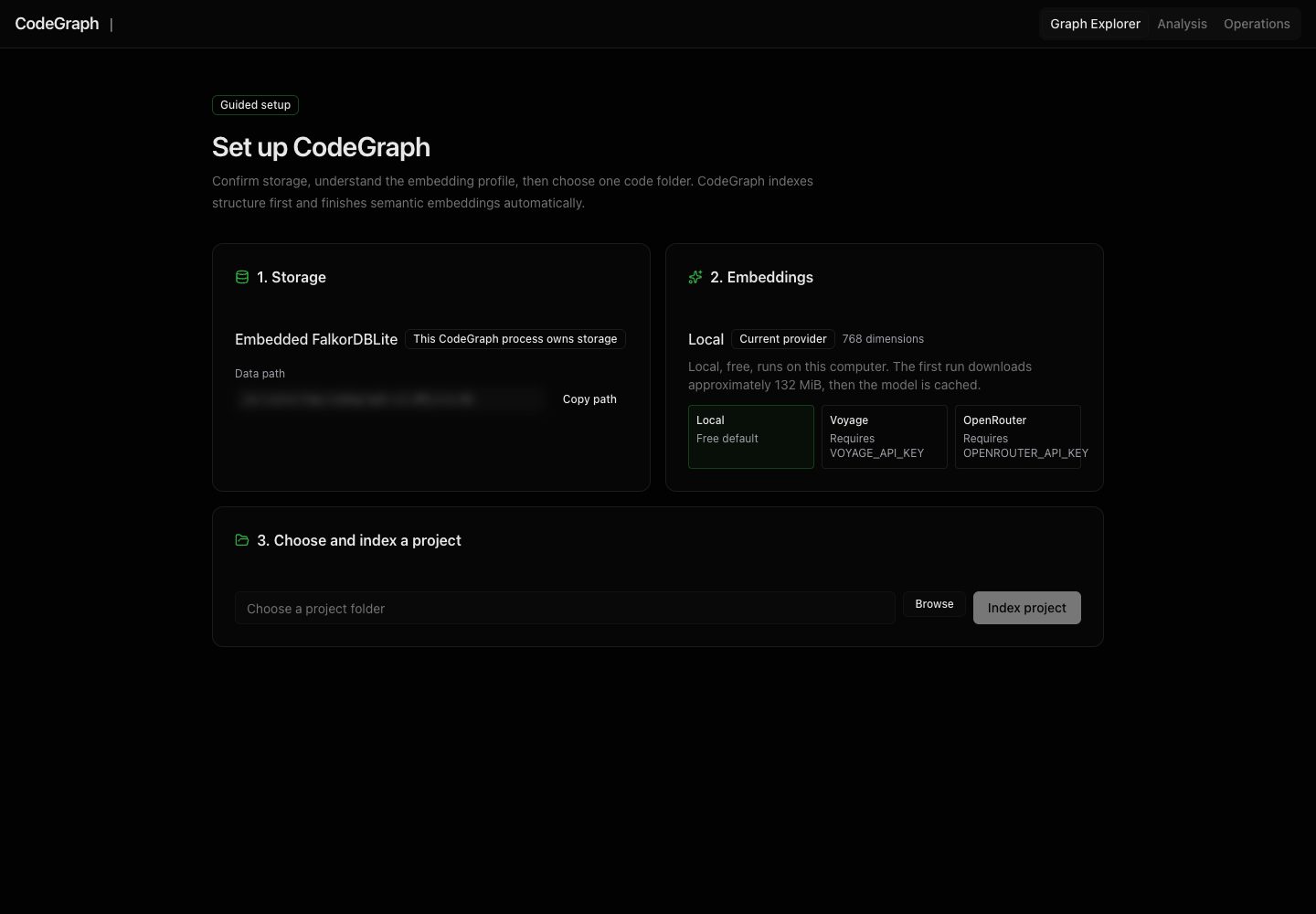
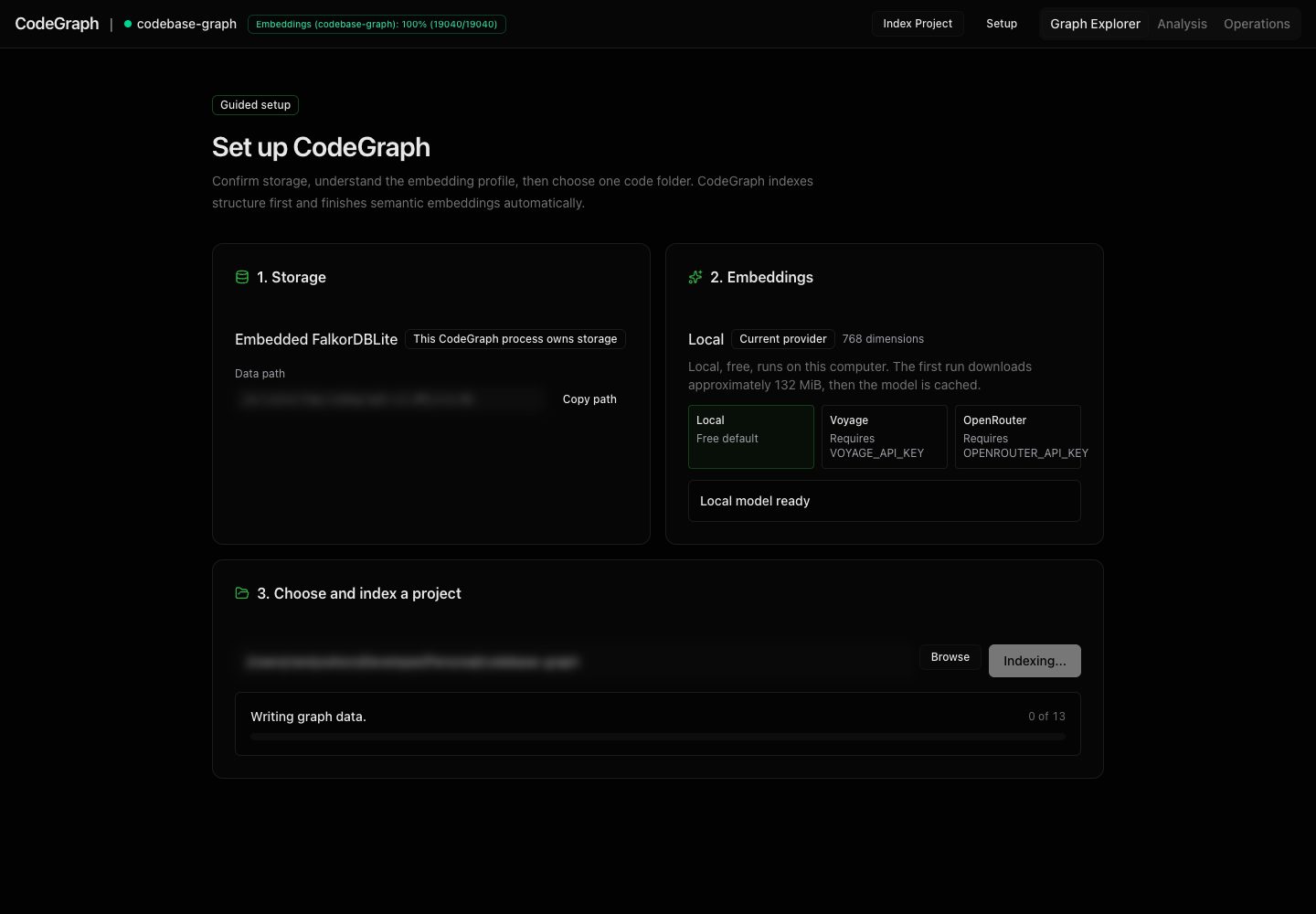
Zero-config first run
The dashboard reports what it is doing instead of hiding first-run work. Storage ownership, embedding provider and dimension, structure progress, model download state, and final counts remain visible.
codegraph-dashboard serves the API and dashboard from the same origin. On supported systems it opens embedded storage without a separate Redis install.
Use the guided setup to confirm storage and the active embedding profile, then choose the code folder you want to index.
Structure lands first. Embeddings continue automatically with file counts, phases, and local model download progress when a model is not cached.
Explorer proof
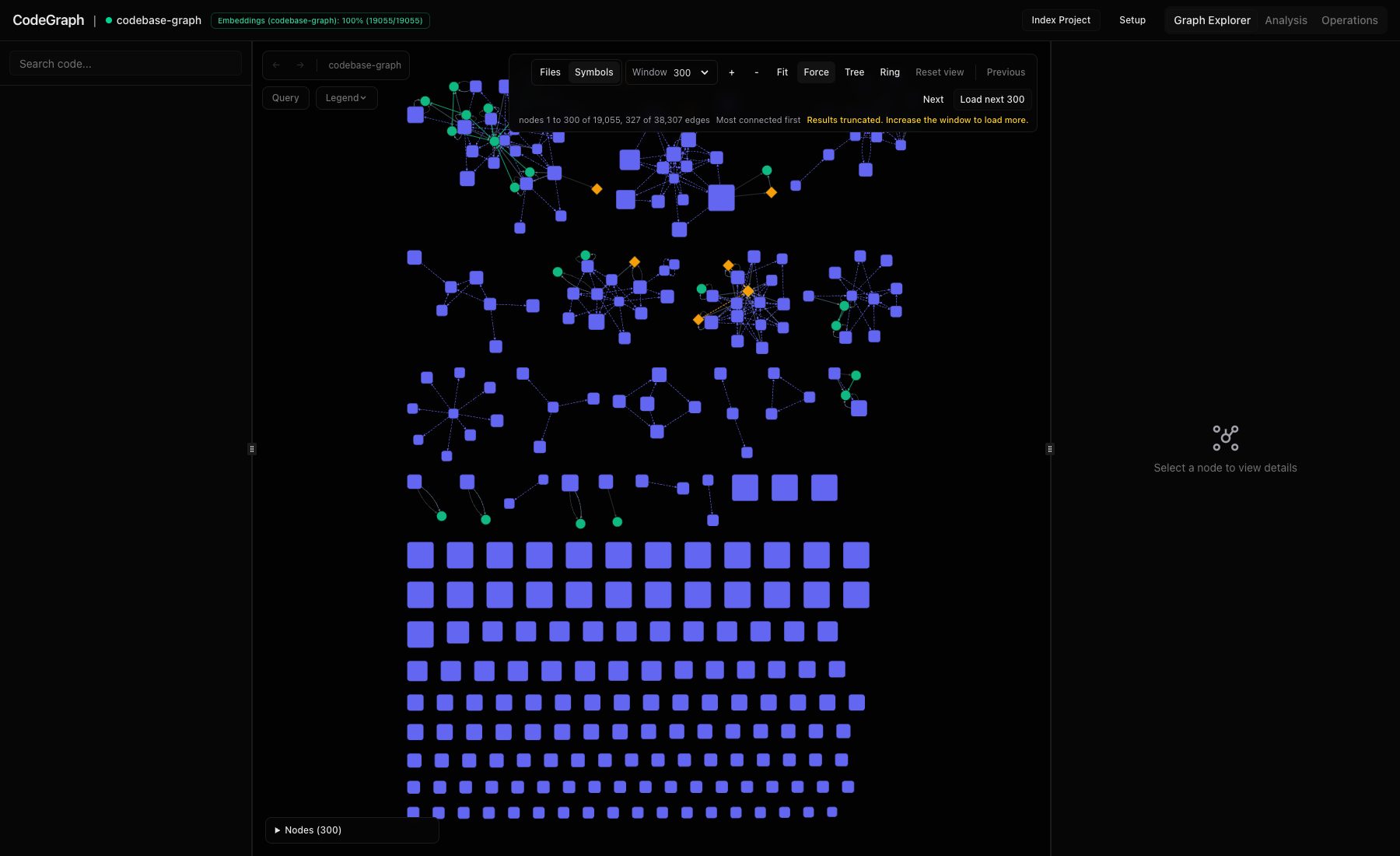
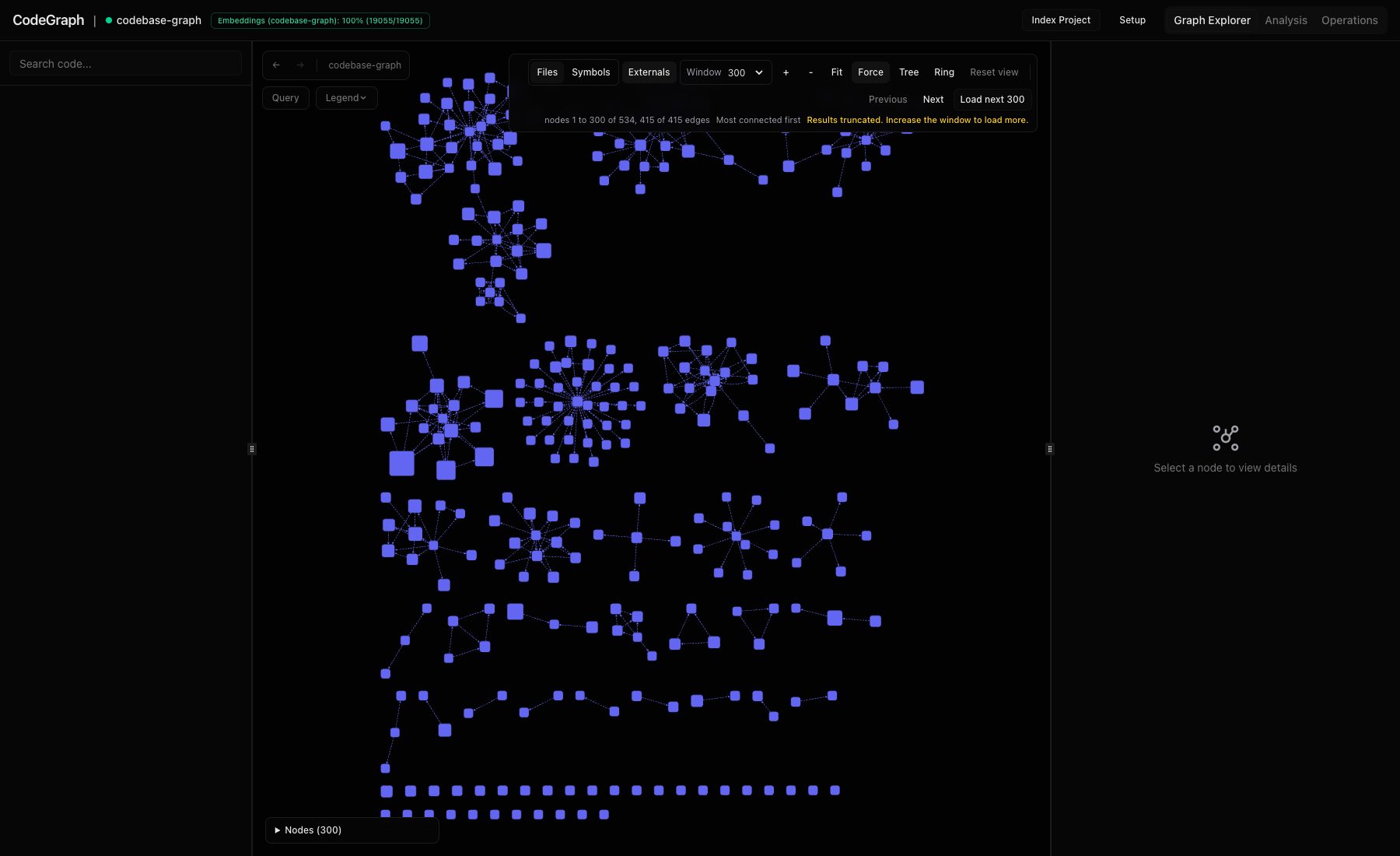
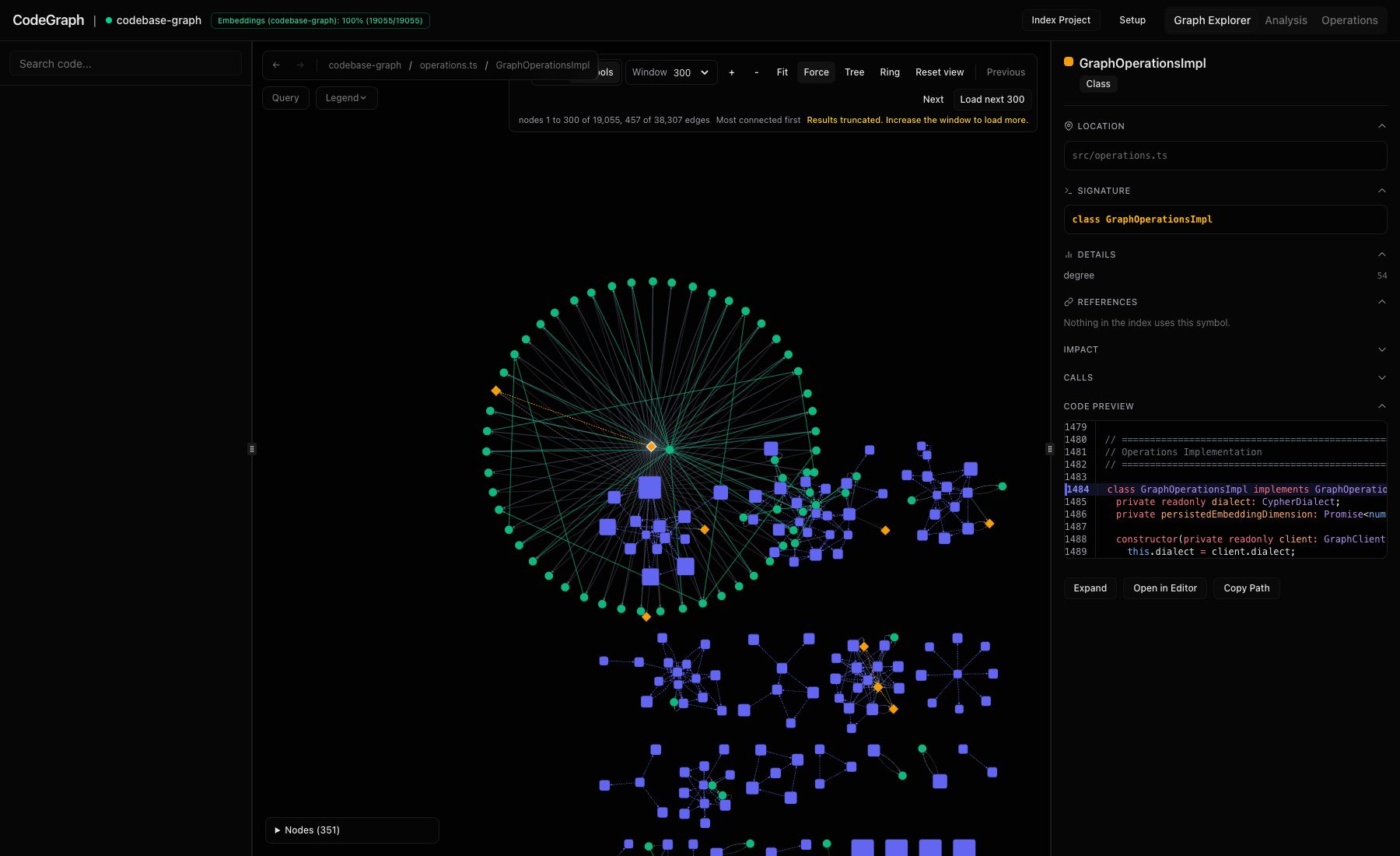
CodeGraph reports exact totals while rendering bounded windows. On this final project-scoped index, the explorer counted 19,055 visible nodes. Its 1,000-node compact response was 305,248 bytes instead of 750,767 bytes, 59% smaller than the legacy wire format.
Switch between Files and Symbols. Files mode adds an Externals visibility toggle for unresolved module nodes.
Windows are ordered most connected first. Use Previous and Next for pages, or Load next to append another window without losing the current graph.
Select a node and add its neighbors around it. Existing positions, pan, and zoom stay intact so exploration keeps its spatial context.
Analysis
The analyze tool does not collapse uncertainty into a score. Responses include display-ready caveats and truncation metadata. Git-backed results also include historyCoverage.
Static results do not prove runtime behavior. Ownership, hotspots, and coupling cover indexed history only.
First sync defaults to 365 days and at most 10,000 commits. Later requests are widen-only. MCP reindex, REST parse, and CLI extraction expose the history options.
Bounded static blast radius from a persisted symbol.
Canonical cycles within one project root.
Direct callers, callees, or both.
Unreferenced export candidates, not runtime proof.
Change frequency ranked with complexity or degree.
Files that changed together in indexed history.
Per-file contributors ranked from indexed git authorship.
Search and knowledge
With no cloud embedding key configured, CodeGraph uses nomic-ai/nomic-embed-text-v1.5 locally at 768-dimensional output. The model downloads on first use and stays cached for later runs.
Semantic results can include callers, callees, complexity, and linked project knowledge. Optional Voyage reranking can refine vector order when configured.
Add text, URLs, and supported documents to the same graph. Valid and invalid timestamps preserve fact timelines and supersession instead of overwriting context silently.
Voyage and OpenRouter embeddings are opt-in profiles. Switching an existing graph to a different provider or dimension requires an explicit re-embed migration.
Storage and platform
One process owns the FalkorDBLite lease. A second CodeGraph process attaches through the published socket, and closing an attached process does not release the owner's lease.
Embedded by default
The platform package bundles the server and graph module binaries. No separate Redis installation and no driver variable are required.
Embedded with native libraries
Install Homebrew libomp and openssl@3. The remaining embedded server and module binaries ship with the platform package.
External FalkorDB
Configure an external FalkorDB endpoint. Explicit external configuration also takes precedence on otherwise supported embedded platforms.
Release confidence
The release gate installs the exact npm tarball it plans to publish, then records and rechecks its SHA-256 instead of testing workspace source in its place.
25 installed-package assertions run across Linux x64 and macOS arm64 embedded lanes, with explicit Windows x64 external-storage guidance.
A Linux x64 lane can start from an empty local-model cache and prove download reporting plus a usable 768-dimensional vector index.
@agntk/codegraph-mcp@0.1.0 is available from the public npm registry with the codegraph-mcp and codegraph-dashboard bins.